The Progressive Era: A Timeline1900 - 1914 |
|||||||
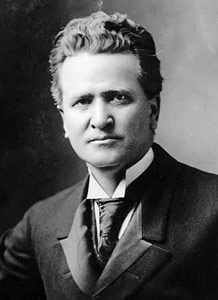
". . .our very democracy so long presupposed that each citizen should care for himself that we are slow to develop a sense of social obligation." |
"Man has always sought the mastery of his fellow-man. To enslave his fellow in some form and to live out of his labor has been the mainspring of human action. . . . In all the ages of the past, human society has been organized and maintained upon the basis of the exploitation and degradation of those who toil. And so it is today. The chief end of government has been and is to keep the victims of oppression and injustice in subjection." |
"I believe in a larger use of the governmental power to help remedy industrial wrongs . . . ." |
|||||
 |
Year |
Event |
Links |
|
|||
1900 |
William McKinley (Rep) defeats Bryan (Dem) in the race for the Presidency. In China, the Boxer Rebellion begins, as an attempt by Chinese nationalists to throw off foreign domination and exploitation. For self-interested economic reasons, the US sends troops to crush the rebellion. A reform innovation, city management by commission, is established in Galveston, Texas. Robert La Follette, more truly a Progressive than Theodore Roosevelt, begins the first of three terms as a reform governor of Wisconsin. He fights for legislation to regulate corporations for the public good, provide for conservation of natural resources, and governance uncorrupted by business influence. Theodore Dreiser's controversial first novel, Sister Carrie, appears in print. |
||||||
1901 |
The US Socialist Party is established at Indianapolis, Indiana. McKinley is assassinated; Theodore Roosevelt becomes US President. US Steel, an immense trust, is organized by financier J. P. Morgan. (Morgan works 200,000 men 12 hours a day at wages that barely keep their families alive. Trusts, large mergers of corporations, were established largely to eliminate competition and gain total control of a market.) Modern oil industry is born with the drilling of "spindletop" in Texas. The Hay-Pauncefote Treaty paves the way for US to construction of the Panama Canal. Under the "Platt Amendment" Cuba becomes a "protectorate" (imperialist acquisition). US claims the right to establish a military base at Guantanamo Bay, as well as the right to control Cuba's international commitments, economy, and internal affairs. Roosevelt invites black educator Booker T. Washington to the White House, generating immense controversy, particularly among southern racists. Washington's biography Up from Slavery is published the same year. |
||||||
1902 |
The United Mine Workers go on strike in Pennsylvania. In the first Federal intervention in a labor dispute, Roosevelt forces mine owners to arbitrate with the miners. Employer's liability laws for workmen's compensation are passed at the state level from 1902 forward, beginning in Maryland. The Reclamation Act of 1902 makes possible the initiation of a large-scale program of federal irrigation and hydroelectric development , primarily in arid western lands. Women's right to vote is recognized — in Australia, but not yet in the US. |
||||||
1903 |
The January issue of McClure's Magazine initiates "muckraking" journalism with articles on municipal government, labor, and trusts (the latter written by Ida M. Tarbell). Roosevelt establishes a cabinet-level Department of Commerce and Labor. Seeking to expand the weak and ineffectual powers of the Interstate Commerce Commission, the Elkins Act is passed, which made the acceptance of "rebates" punishable. (Rebates were a practice engaged in by John D. Rockefeller to crush competitors in the oil business.) The Ford Motor Company is established. Jack London's novel Call of the Wild is published. Philosopher John Dewey and seven associates publish Studies in Logical Theory, establishing Pragmatism as a school of philosophy. Pragmatism incorporates a strong steak of moral relativism. The US backs Panama in a revolt against Columbia. The Panama Canal Zone is placed under American jurisdiction. The US acquires Guantanamo Bay naval station in Cuba. The first national wildlife refuge, Pelican Island in Florida, is established. The Wright Brothers achieve powered flight. |
Department of Commerce and Labor Jack London's Call of the Wild Pelican Island Wildlife Refuge
|
|||||
1904 |
The prosecution of a a railroad holding company proves successful in Northern Securities Company v. United States, an important "trust-busting" precedent. War breaks out between Russia and Japan. Roosevelt is elected to his second term in office. Potential European intervention in Latin America is challenged with the announcement of the "Roosevelt Corollary" to the Monroe Doctrine. This commits the US to "policing" the area. A St. Louis exposition popularizes hamburgers and the ice cream cone is invented. Cooking with electricity is showcased, along with other "marvels of technology". |
Northern Securities Company v. United States
|
|||||
1905 |
Another successful prosecution of a trust, in this case a beef trust, is launched with Swift and Company v. United States. The war between Russia and Japan comes to an end, with Roosevelt brokering the Treaty of Portsmouth (at Portsmouth, New Hamshire). Russia is forced to abandon its campaign of imperialism in Asia. The Socialist weekly magazine Appeal to Reason begins serial publication of author Upton Sinclair's book, The Jungle, which reveals the horrors of the meat packing industry. The Industrial Workers of the World is founded, an umbrella organization comprised of a variety of leftist groups. The group was later nicknamed the "Wobblies". Americans return Roosevelt to the Presidency with a resounding victory. |
Swift and Company v. United States Industrial Workers of the World
|
|||||
1906 |
Construction of the Panama Canal begins. The Hepburn Act is passed, which serves to strengthen the Interstate Commerce Commission. This gives the federal government greater control over the railroad companies. The Meat Inspection Act and Pure Food and Drug Act are both passed, a direct consequence of the writings of investigative journalists (the "muckrakers"). The Cuban Conservative party is accused of using fraudulent means of winning an election, and the revolution of 1906 follows. US troops invade Cuba to quell the rebellion. US crushes attempt at Philippine independence. The Antiquities Act opens the door to the establishment of the nation's first monument, Devil's Tower in Wyoming. Many more were added over the course of the next few years. Roosevelt receives the Nobel Peace prize for his role in brokering the Treaty of Portsmouth that brought an end to the Russo-Japanese war. The right of women to vote in national elections is recognized in Finland. H. G. Wells publishes The Future in America, a kind of updating of Tocqueville's Democracy in America . |
||||||
1907 |
Japanese immigration is barred from the US by Roosevelt in a "Gentlemen's Agreement" with Japan. Roosevelt, intent on displaying US military might, launches the "Great White Fleet". Coal mine explosions kill 361 people in West Virginia. US lands marines in Honduras to intervene in a revolution against Honduran dictator Manuel Bonilla. |
||||||
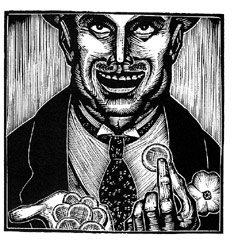 Like many Americans, Progressive artist Lynd Ward believed businessmen like J. P. Morgan cared about nothing but money. |
|
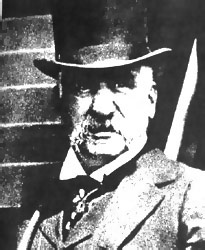 Businessman J. P. Morgan. Roosevelt went after his trust first. (Image: Archive Photos/Camera Press) |
|||||
I was from Connecticut, whose Constitution declares "that all political power is inherent in the people, and all free governments are founded on their authority and instituted for their benefit; and that they have at all times an undeniable and indefeasible right to alter their form of government in such a manner as they may think expedient." Mark Twain |
"To you . . . who have come here . . . to launch a new party, a party of the people of the whole Union, the National Progressive party, I extend my hearty greeting. You are taking a bold and a greatly neeeded step for the service of our beloved country. The old parties are husks, with no real soul within either, divided on artificial lines, boss-ridden and privilege-controlled, each a jumble of incongruous elements, and neither daring to speak out wisely and fearlessly what should be said on the vital issues of the day." Theodore Roosevelt |
"So far, war has been the only force that can discipline a whole community, and until an equivalent discipline is organized, I believe that war must have its way. But I have no serious doubt that the ordinary prides and shames of social man, once developed to a certain intensity, are capable of organizing such a moral equivalent . . . ." William James |
|||||
1908 |
Robert LaFollette notes that the US economy is dominated by fewer than 100 men, all of whom were controlled by J. P. Morgan and Standard Oil investment banking groups. Works to pass the Aldrich-Vreeland Currency Act to regulate the banking industry. Roosevelt appoints a national commission for conserving natural resources. William Taft, a former attorney who really wanted to be a Supreme Court Justice, becomes president. He proves inept, timid, and conservative. Race riots in Springfield, Illinois, which lead to the establishment of the NAACP in 1909. Henry Ford begins marketing an affordable automobile, the "Model T", to Americans. The FBI, the American "political police force", is established. The Eight, a group of American painters concerned with bringing art into closer touch with life, exhibit together in New York City. This initiates perhaps the most important current in 20th-century US art. |
|
|||||
1909 |
The NAACP is established. An expansion of the Homestead Act of 1862 is passed, the Enlarged Homestead Act, accelerating settlement of Western states. The "Great White Fleet" returns, after circling the globe. The 16th constitutional amendment is approved, authorizing the federal government to collect income taxes. The president of Nicaragua is forced to leave office by US. |
||||||
1910 |
Author Mark Twain dies. American philosopher and psychologist William James also dies this year. Franklin Delano Roosevelt wins a seat in the state senate of New York. The Mann-Elkins Act places interstate communications utilities under the Interstate Commerce Commission. Hiram Johnson is elected Governor of California. He ends corruption of Californian politics by the Southern Pacific Railroad, and pushes through an extensive program of Progressive reforms. Under Taft, hyper-conservative Joseph Cannon uses the office of Speaker of the House to block progressive legislation. Progressive Republicans and Democrats alike join forces to reduce the powers of the office. US sociologist William Graham Sumner, whose theories of Social Darwinism had provided intellectual cover for the depredations of the industrialists, dies. |
|
|||||
1911 |
US helps to overthrow the president of the Honduras. Triangle Shirtwaist Company fire in a New York City sweatshop results in the deaths of 147 employees, some of whom leapt to their deaths because they were trapped in the building where they worked. The Supreme Court dissolves the Standard Oil Company, in light of its violation of the Sherman Antitrust Act. |
||||||
1912 |
Textile workers strike in Lawrence, Massachusetts. The luxury ocean cruiser Titanic sinks off the coast of Halifax, Nova Scotia. The Lloyd-La Follette Act is passed, giving federal employees the right to communicate with Congress. Woodrow Wilson elected president. The Financier is published, the first novel of a trilogy (the Trilogy of Desire) by Theodore Dreiser concerning the life of a morally corrupted financier. |
|
|||||
1913 |
The first US minimum wage law is enforced in Oregon. Progressive artists open the Armory Art Show in New York, New York. The Eight and the Ashcan School show up disoriented "modern" European art also included in the show. Norway recognizes the right of women to vote. The US still lags. Woman march for suffrage in Washington, DC. The 17th Constitutional Amendment is adopted, providing for the direct election of senators, rather than by state legislatures. The Federal Reserve System is established, and begins to provide central banking by privately owned banks, initiating permanent deficits. The Department of Labor is split from the Department of Commerce. Sociologist and philosopher Lester Ward, who had argued for rational, systematic planning for a better society, dies. |
|
|||||
1914 |
The Archduke of Austria is assassinated in Sarajevo. Of no immense significance in itself, the event serves as the pretext for Germany to declare war on Russia, initiating World War I. Some 9 million men, woman and children die for nothing, entire countries are brought to ruination, and the stage is set for World War II. Striking miners and family members in Ludlow, Colorado are murdered by mine owners. The construction of the Panama Canal is completed. In August, the first ocean vessel steams through. Many states have minimum-age child labor laws (typically set at 14 years of age); there is as of yet no federal protection. The Federal Trade Commission is established, and begins to function to regulate interstate commerce. First great financial panic of the 20th century occurs. |
||||||
|
The Progressive Era: A Timeline |
|
|||||